LED strip lights have revolutionized how we illuminate and decorate our spaces, transforming ordinary rooms into vibrant, dynamic environments. From enhancing a gaming setup to setting the perfect mood for a relaxed evening, these versatile lighting solutions offer unparalleled flexibility. Among the most popular options, RGB and RGBIC technologies stand out, each offering distinct capabilities. But what exactly sets them apart, and which one is the right choice for your specific needs? This guide will dive deep into the nuances of RGB and RGBIC LED strip lights, helping you understand their core differences and empowering you to make an informed decision for your next lighting project.
Understanding LED Strip Lights: An Overview
LED strip lighting consists of flexible circuit boards populated with numerous light-emitting diodes (LEDs). These strips, typically backed with an adhesive, can be easily installed on various surfaces, bending and conforming to different shapes. Initially, LED strips were primarily used for accent lighting or subtle backlighting, offering simple white or single-color illumination. Over time, advancements in technology led to the development of multi-color options, paving the way for the sophisticated RGB and RGBIC systems we see today. Their diverse applications span from decorative home lighting, under-cabinet illumination, and TV backlighting to professional architectural accents and vibrant commercial displays, proving their adaptability in almost any setting where creative lighting is desired.
RGB LED Strip Lights: The Foundation of Color
RGB stands for Red, Green, and Blue, representing the three primary colors of light in the additive color model. In an RGB LED strip, each individual LED package contains three separate diodes: one for red, one for green, and one for blue. By adjusting the intensity (brightness) of each of these three colors, an RGB LED can produce a vast spectrum of millions of different hues.
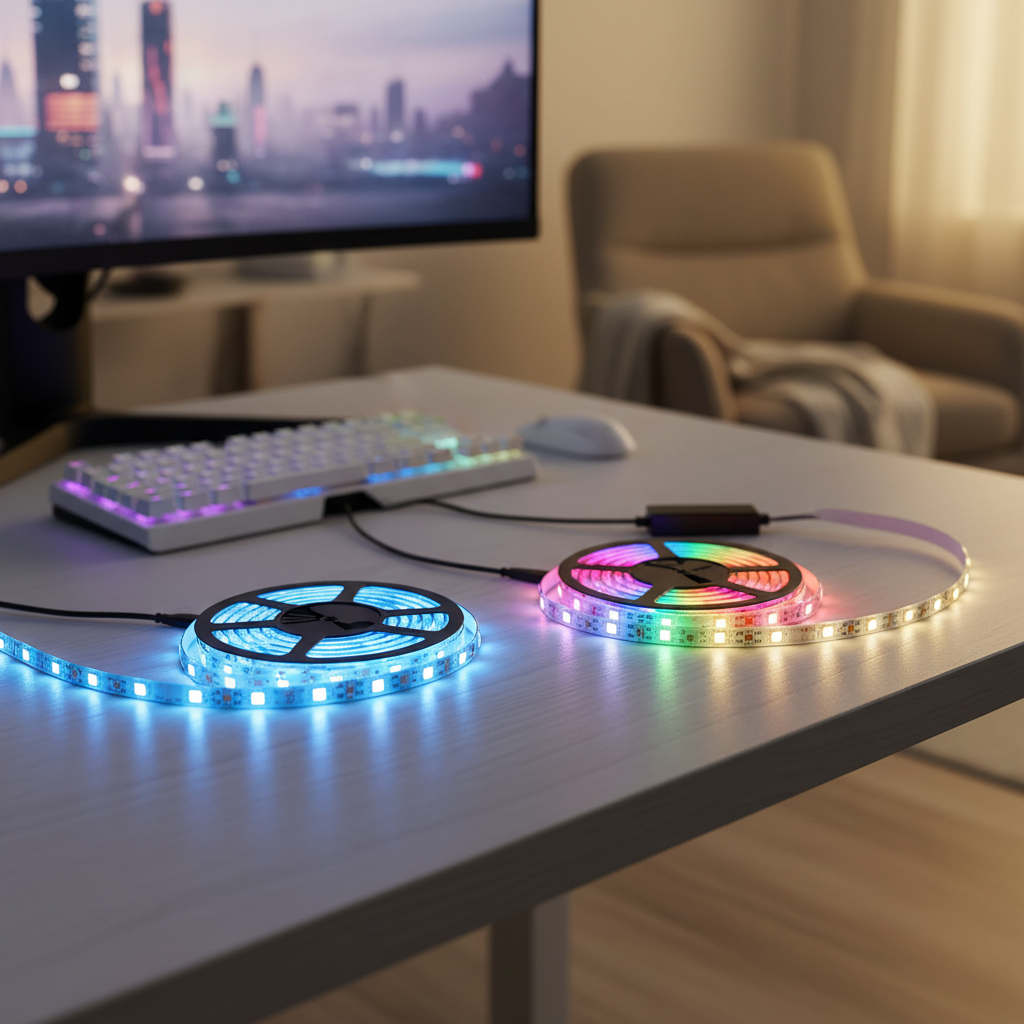
The fundamental principle of RGB operation is that all LEDs on a segment or the entire strip are controlled by a single circuit chip. This means that at any given moment, the entire strip will display one uniform color. For example, if you set an RGB strip to purple, every LED on that strip will glow purple. This unified color output makes RGB strips an excellent choice for creating consistent ambient lighting, setting a specific mood, or adding a solid color accent to a room. Their simplicity in design and control, coupled with their ability to produce a wide array of colors, makes them a classic and cost-effective solution for many lighting applications. While they offer various colors, their limitation lies in displaying only one color across the entire strip simultaneously.
RGBIC LED Strip Lights: The Next Evolution in Dynamic Lighting
RGBIC takes the concept of multi-color LED lighting to an advanced level by incorporating an “Integrated Circuit” (IC) chip. This crucial addition differentiates RGBIC strips from their RGB counterparts. Unlike RGB strips, where all LEDs are controlled uniformly, RGBIC strips feature multiple ICs distributed along the length of the strip. Each IC chip controls a specific segment of LEDs independently.
This integrated circuit technology allows for individual control over different sections of the LED strip. This means that an RGBIC strip can display multiple colors simultaneously along its length, creating dynamic and complex lighting effects that are impossible with standard RGB. Imagine a rainbow effect flowing across your strip, a chasing light pattern, or a gradient fading from blue to green to red all at once. These vibrant, animated sequences are the hallmark of RGBIC technology. They are particularly favored for gaming setups, entertainment areas, or any space where a lively, eye-catching, and highly customizable light show is desired. The ability to choreograph intricate light patterns makes RGBIC strips a powerful tool for expressive and immersive lighting designs.
RGB vs. RGBIC: A Detailed Comparison
Understanding the technical distinctions between RGB and RGBIC is crucial for choosing the right lighting solution. The presence of integrated circuits in RGBIC technology fundamentally alters how colors are displayed and controlled.
| Feature | RGB LED Strip Lights | RGBIC LED Strip Lights |
|---|---|---|
| Control | Entire strip displays one uniform color at a time. | Individual control over segments. |
| Color Display | Single color across the entire strip. | Multiple colors simultaneously on different segments. |
| Dynamic Effects | Basic fading, flashing, static colors. | Advanced gradients, chasing, flowing, multi-color patterns. |
| Integrated Circuits | One main controller for the entire strip. | Multiple Integrated Circuits (ICs) for segmented control. |
| Flexibility (Cutting) | Often cuttable at designated points. | Generally not cuttable; cutting may disable segments. |
| Cost | More budget-friendly. | Higher cost due to advanced technology. |
| Ideal For | Ambient lighting, single-color mood setting. | Complex lighting scenes, gaming setups, accent lighting with dynamic effects. |
Choosing the Right LED Strip Light: A Buying Guide
Selecting between RGB and RGBIC LED strip lights depends heavily on your specific needs, desired aesthetics, and budget. Here’s a comprehensive guide to help you make the best choice:
- Assess Your Needs: Begin by clarifying the primary purpose of your LED strip lights. Are you looking for simple ambient lighting to set a mood with a single color, or do you envision dynamic, multi-color effects, such as flowing rainbows or chasing patterns? For straightforward, uniform color, RGB is sufficient. For intricate light shows and advanced customization, RGBIC is the clear winner.
- Location and Environment: Consider where the lights will be installed. For indoor applications like under-cabinet lighting or subtle backlighting, both can work. If you need robust strips for specific outdoor use, ensure the chosen product (RGB or RGBIC) has an appropriate IP rating for weather resistance.
- Budget Considerations: RGB strip lights are typically more affordable due to their simpler technology. If budget is a primary concern and your lighting needs are basic, RGB provides excellent value. RGBIC strips, with their advanced control capabilities, come at a higher price point.
- Installation and Flexibility: If you anticipate needing to cut your LED strips to fit precise lengths, standard RGB strips often offer more flexibility in this regard, with clearly marked cutting points. Many RGBIC strips are not designed to be cut, as it can disrupt the integrated circuit and render segments inoperable. Always check the product specifications regarding cuttable lengths.
- Smart Features & Control: Both RGB and RGBIC strips often come with app control, allowing you to select colors, adjust brightness, and choose effects from your smartphone. Many also integrate with smart home ecosystems like Amazon Alexa or Google Assistant for voice control. If advanced effects are crucial, ensure the RGBIC strip’s app offers the level of customization you desire.
- Brand Reputation & Quality: Regardless of the technology, always opt for reputable brands known for quality and reliability. Read user reviews and check for certifications to ensure you’re getting a durable and safe product.
Top Brands in LED Strip Lighting
The market for LED strip lights is vibrant and competitive, with several brands offering high-quality RGB and RGBIC options. Companies like Govee have become particularly well-known for their innovative RGBIC products, providing a wide range of strips with advanced features, extensive app control, and seamless integration with smart home systems. Other notable brands also offer compelling solutions, often focusing on ease of use, durability, or specific feature sets like music synchronization or robust outdoor ratings. When choosing, researching the brand’s specific offerings for either RGB or RGBIC technology, and considering their customer support and community feedback, can greatly enhance your overall experience.
Installation and Maintenance Tips for Your LED Strip Lights
Proper installation and thoughtful maintenance are key to maximizing the lifespan and performance of your LED strip lights.
Installation Basics
|
Our Picks for the Best LED strip light in 2026
As an Amazon Associate I earn from qualifying purchases.
|
||
| Num | Product | Action |
|---|---|---|
| 1 | DAYBETTER Led Strip Lights 32.8ft Kit with Remote and Power Supply Color Changing |

|
| 2 | Govee White LED Strip Lights, Upgraded 16.4ft Dimmable LED Light Strip 6500K Bright Daylight White, Strong Adhesive, 300 LEDs Flexible Tape Lights for Mirror, Kitchen Cabinet, Bedroom, Christmas Decor |
|
| 3 | dalattin White LED Strip Lights, 20ft Dimmable Super Bright 24V Led Tape Light 6500K 360 LEDs Lights for Bedrooms, Mirror, Kitchen, Home Decoration Daylight White |
|
| 4 | NBBUFF Led Lights for Bedroom 50ft (1 Roll), Color Changing RGB Led Strip Lights with 60 Keys Remote and App Control, Music Sync Led Lights for Room Kitchen Party Home Decor |
|
| 5 | Govee RGBIC LED Strip Lights, Smart LED Lights for Bedroom, Bluetooth LED Lights APP Control, DIY Multiple Colors on One Line, Color Changing LED Strip Lighting Music Sync, Home Decor, 16.4ft |
|
| 6 | DAYBETTER LED Strip Lights 110ft, Smart Lighting Strips with App Remote Control, RGB Music Sync Color Changing Lights for Bedroom Kitchen Party Home Decor Luces led para cuarto (1 Roll) |
|
| 7 | KSIPZE 100ft Led Strip Lights RGB Music Sync Color Changing Led Lights with Smart App Control Remote Led Lights for Bedroom Room Lighting Flexible Home Décor |
|
| 8 | Barrina (6 Pack LED T5 Integrated Single Fixture, 4FT, 2200lm, 6500K Super Bright White, 20W Utility LED Shop Light, Ceiling and Under Cabinet Light, Corded Electric with ON/Off Switch, ETL Listed |
|
| 9 | White Led Strip Lights for Bedroom Small Dimmable LED Lights Strip 16.4ft Super Bright Flexible LED Tape Lights Rope Light for for Room Home Decor Luces Leds for Living Room Kitchen Vanity Mirror |
|
| 10 | Govee 100ft RGBIC LED Strip Lights, Smart LED Lights Work with Alexa and Google Assistant, LED Lights for Bedroom WiFi App Control Segmented DIY Multiple Colors, Color Changing Light, (2 x 50ft) |
|
Before installation, ensure the surface is clean, dry, and smooth for optimal adhesive performance. Measure accurately and plan your layout to avoid unnecessary cutting, especially with RGBIC strips. For turns and corners, avoid sharp bends; instead, use connectors or flexible corners to prevent damage to the circuit board. Always ensure the power supply matches the voltage requirements of your LED strip to prevent overheating or underperformance.
Electrical Safety
When working with any electrical components, safety is paramount. Always disconnect power before installing or adjusting your LED lights. Use the appropriate power adapter for your strip. If you’re unsure about wiring or electrical connections, it’s advisable to consult a qualified electrician.
Care and Longevity
To extend the life of your LED strips, keep them clean from dust and debris with a soft, dry cloth. Avoid exposing them to extreme temperatures or direct sunlight for prolonged periods, as this can degrade the adhesive and the LEDs. For RGBIC strips, be particularly careful not to bend the strip excessively at the points where the IC chips are located, as this can damage the individual control segments.
Troubleshooting
Common issues like flickering lights or dead segments can often be resolved with simple checks. Ensure all connections are secure and the power supply is functioning correctly. For smart strips, verify your Wi-Fi or Bluetooth connection and check the accompanying app for any error messages or firmware updates. If a segment on an RGBIC strip goes out, it might indicate damage to that specific IC chip, reinforcing the importance of careful handling.
Conclusion
Both RGB and RGBIC LED strip lights offer fantastic opportunities to transform any space with vibrant illumination. The choice between them ultimately boils down to the complexity and dynamism you desire from your lighting. RGB strips provide a simpler, cost-effective way to bathe a room in a single, uniform color, perfect for subtle mood lighting and classic accents. RGBIC technology, with its integrated circuits and individual segment control, unlocks a world of advanced, multi-color effects, gradients, and animated patterns, making it ideal for those who crave dynamic, personalized light shows. By considering your specific needs, budget, and desired visual impact, you can confidently select the LED strip technology that best illuminates your vision. Which technology will light up your next project?
Frequently Asked Questions
What is the main difference between RGB and RGBIC LED strips?
The main difference lies in their control capabilities. RGB strips display one uniform color across the entire strip at any given time, as all LEDs are controlled by a single circuit. RGBIC strips, however, incorporate integrated circuits (ICs) that allow for individual control of separate segments, enabling multiple colors to be displayed simultaneously along the strip for dynamic effects.
Can I cut RGBIC LED strip lights?
Generally, no. Most RGBIC LED strips are not designed to be cut. Cutting an RGBIC strip at an unauthorized point can disrupt the integrated circuits, causing segments of the strip to become non-functional. Always check the product specifications; some specific models might have designated cutting points, but this is not a universal feature like it is with many RGB strips.
Are RGBIC lights brighter than RGB lights?
Brightness can vary significantly between models and manufacturers for both RGB and RGBIC lights, depending on the LED density and power output. While some RGBIC strips may offer higher brightness due to advancements in technology and overall design, it is not an inherent characteristic solely tied to the RGBIC designation. Always check the lumen output specifications when comparing brightness.
Which is better for gaming setups, RGB or RGBIC?
For gaming setups, RGBIC is generally preferred. Its ability to display multiple colors simultaneously and create dynamic, flowing effects (like chasing lights or gradients) significantly enhances the immersive experience, often syncing with on-screen action or audio. While RGB can provide vibrant static backlighting, RGBIC offers a much more engaging and customizable visual spectacle.
Do RGBIC lights work with smart home systems?
Yes, most modern RGBIC LED strip lights are designed to integrate seamlessly with popular smart home ecosystems, including Amazon Alexa, Google Assistant, and sometimes Apple HomeKit. They typically connect via Wi-Fi or Bluetooth, allowing for voice control, app-based customization, scheduling, and integration into broader smart home automation routines. Always verify compatibility with your specific smart home system before purchasing.