LED strip lights have revolutionized modern lighting, offering incredible versatility and ambiance. However, achieving their full potential and ensuring a long, reliable lifespan hinges on one critical factor: correctly calculating and choosing the right power supply. An undersized power supply can lead to dim, flickering lights and premature failure, while an oversized one is an unnecessary expense. This guide, drawing on over a decade of hands-on experience, will demystify the process, providing you with the essential knowledge and step-by-step instructions to perfectly match your LED strips with their power needs.
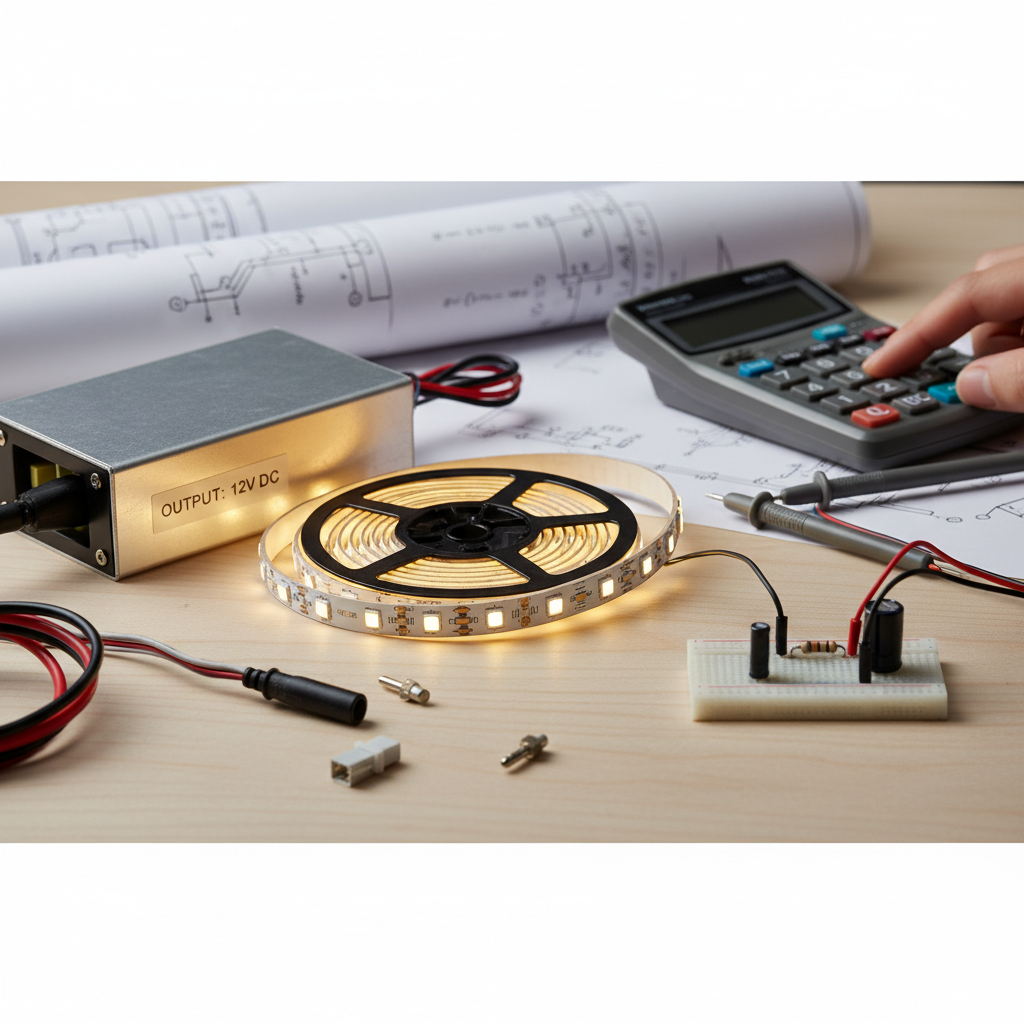
Understanding LED Strip Lights: Key Specifications for Power Calculation
Before diving into calculations, it’s crucial to understand the fundamental specifications of your LED strip lights. These details are typically found on the product packaging, specification sheet, or printed directly on the strip itself. The two primary specifications you’ll need are the operating voltage and the power consumption per unit of length.
Most LED strip lights operate on low voltage Direct Current (DC), commonly 12V or 24V. Matching this voltage with your power supply is non-negotiable for safe and effective operation. The power consumption is usually expressed in Watts per meter (W/m) or Watts per foot (W/ft). This rating indicates how much electrical power the strip consumes for every unit of its length. Factors like LED density – the number of LEDs packed into a specific length – directly influence this wattage rating. Higher density strips, which offer brighter and more uniform illumination, naturally draw more power per meter than lower density versions. Understanding these core figures is the first step toward a flawlessly lit project.
Why Accurate Power Supply Calculation is Crucial for LED Strip Performance
Selecting the correct power supply isn’t just a technical detail; it’s fundamental to the performance, longevity, and safety of your LED strip lighting system. An incorrectly sized power supply can lead to a host of frustrating and potentially costly issues. For instance, an underpowered system might exhibit noticeable dimming towards the end of longer runs, or worse, persistent flickering that detracts from the aesthetic appeal and can even cause eye strain.
Beyond aesthetic problems, an inadequate power supply can drastically shorten the lifespan of your LED strips and the power supply itself. When a power supply is consistently pushed beyond its rated capacity, it overheats, leading to internal component degradation and eventual failure. This not only necessitates costly replacements but also poses a safety risk due to excessive heat generation. Conversely, choosing a power supply that is significantly oversized, while not harmful, can be an unnecessary expense, adding to project costs without providing any additional benefits. Precision in calculation ensures your LEDs operate at optimal brightness, maintain consistent color, and provide years of trouble-free service.
Essential Factors and Formulas for LED Strip Power Supply Calculation
Calculating the appropriate power supply for your LED strip lights is a straightforward process once you understand the key variables and the underlying formulas. The primary goal is to determine the total wattage required by your LED strips and then select a power supply that can comfortably meet and exceed that demand.
The fundamental formula to calculate the theoretical total wattage of your LED strip is:
Total Wattage (W) = Length of LED Strip (meters) × Watts per meter (W/m)
For example, if you have 5 meters of LED strip rated at 9.6 W/m, your theoretical total wattage would be: 5m × 9.6 W/m = 48 W.
However, this theoretical wattage is not the final figure for selecting your power supply. It is critically important to incorporate a safety margin. Running a power supply at its absolute maximum capacity continuously can lead to overheating and premature failure. Industry best practice recommends adding a 20-30% power margin to your calculated theoretical wattage. This ensures the power supply operates efficiently, safely, and extends its lifespan. So, for our example, with a 20% margin, the required power supply wattage would be 48 W × 1.20 = 57.6 W. With a 30% margin, it would be 48 W × 1.30 = 62.4 W. Always round up to the nearest available power supply wattage.
Several factors influence the actual power consumption of an LED strip and must be considered during the planning phase:
- Length of the Strip: As shown in the formula, longer runs inherently require more power.
- LED Density: Strips with more LEDs per meter will have a higher W/m rating and thus a higher total power draw.
- Brightness Levels: While the W/m rating is for full brightness, consistently running strips at lower brightness via dimmers will reduce actual consumption.
- Color (for RGB/RGBW strips): RGB or RGBW strips can draw more power than single-color strips when all colors are illuminated to produce white light.
Understanding Voltage Drop
Another critical phenomenon, especially for longer LED strip runs, is voltage drop. This refers to the gradual reduction in electrical potential along the length of the strip and its connecting wires. As current travels through the copper traces of the strip and external wires, resistance causes a decrease in voltage.
The effects of voltage drop are often visible as:
- Dimming: Lights at the far end of the strip appear noticeably dimmer than those closer to the power source.
- Color Shift: In RGB strips, different colors may require slightly different voltages, leading to undesirable color shifts (e.g., white appearing pinkish or yellowish) towards the end of the run.
Voltage drop is influenced by:
- Run Length: The longer the wire or LED strip, the greater the voltage drop.
- Wire Gauge (Thickness): Thicker wires (lower AWG number) have less resistance and reduce voltage drop.
- Total Power Consumption: Higher wattage draws more current, which exacerbates voltage drop over distance.
|
Our Picks for the Best LED strip light in 2026
As an Amazon Associate I earn from qualifying purchases.
|
||
| Num | Product | Action |
|---|---|---|
| 1 | Govee White LED Strip Lights, Upgraded 16.4ft Dimmable LED Light Strip 6500K Bright Daylight White, Strong Adhesive, 300 LEDs Flexible Tape Lights for Mirror, Kitchen Cabinet, Bedroom, Christmas Decor |

|
| 2 | Govee 100ft RGBIC LED Strip Lights, Smart LED Lights Work with Alexa and Google Assistant, LED Lights for Bedroom WiFi App Control Segmented DIY Multiple Colors, Color Changing Light, (2 x 50ft) |
|
| 3 | DAYBETTER Led Strip Lights 32.8ft Kit with Remote and Power Supply Color Changing |
|
| 4 | KSIPZE 100ft Led Strip Lights RGB Music Sync Color Changing Led Lights with Smart App Control Remote Led Lights for Bedroom Room Lighting Flexible Home Décor |
|
| 5 | NBBUFF Led Lights for Bedroom 50ft (1 Roll), Color Changing RGB Led Strip Lights with 60 Keys Remote and App Control, Music Sync Led Lights for Room Kitchen Party Home Decor |
|
| 6 | dalattin White LED Strip Lights, 20ft Dimmable Super Bright 24V Led Tape Light 6500K 360 LEDs Lights for Bedrooms, Mirror, Kitchen, Home Decoration Daylight White |
|
| 7 | Barrina (6 Pack LED T5 Integrated Single Fixture, 4FT, 2200lm, 6500K Super Bright White, 20W Utility LED Shop Light, Ceiling and Under Cabinet Light, Corded Electric with ON/Off Switch, ETL Listed |
|
| 8 | DAYBETTER LED Strip Lights 110ft, Smart Lighting Strips with App Remote Control, RGB Music Sync Color Changing Lights for Bedroom Kitchen Party Home Decor Luces led para cuarto (1 Roll) |
|
| 9 | White Led Strip Lights for Bedroom Small Dimmable LED Lights Strip 16.4ft Super Bright Flexible LED Tape Lights Rope Light for for Room Home Decor Luces Leds for Living Room Kitchen Vanity Mirror |
|
| 10 | Govee RGBIC LED Strip Lights, Smart LED Lights for Bedroom, Bluetooth LED Lights APP Control, DIY Multiple Colors on One Line, Color Changing LED Strip Lighting Music Sync, Home Decor, 16.4ft |
|
While precise voltage drop calculations can be complex, involving wire length, current, and resistance, a practical guideline is to aim for less than a 5% voltage drop across your entire circuit. For professional installations where color consistency is paramount, a maximum of 3% is often recommended. If you notice significant voltage drop, solutions include using thicker gauge wiring, reducing the overall length of the strip, or implementing “power injection” where power is supplied at multiple points along a long run.
Here’s an example table illustrating common LED strip wattages and their calculated power supply requirements:
| LED Strip Length | Strip Wattage (W/m) | Theoretical Total Wattage (W) | Recommended Power Supply (25% Margin) |
|---|---|---|---|
| 3 meters (9.8 ft) | 4.8 W/m | 14.4 W | 18 W |
| 5 meters (16.4 ft) | 7.2 W/m | 36 W | 45 W |
| 10 meters (32.8 ft) | 9.6 W/m | 96 W | 120 W |
| 7.5 meters (24.6 ft) | 14.4 W/m | 108 W | 135 W |
Step-by-Step Guide: How to Calculate Your LED Strip Power Supply
Calculating the right power supply for your LED strip lights can be broken down into a few clear steps, ensuring you cover all the necessary considerations for a successful and lasting installation.
Step 1: Determine the Operating Voltage of Your LED Strip Light
Check the product specifications for your LED strip. It will explicitly state the required input voltage, typically either 12V DC or 24V DC. This is a critical piece of information, as your power supply must match this voltage.
Step 2: Identify the Watts per Meter (W/m) or Watts per Foot (W/ft) Rating
Again, consult your LED strip’s specifications. This rating indicates its power consumption per unit of length. For example, you might find “4.8W/m,” “9.6W/m,” or “5W/ft.” Ensure you use the correct unit (meters or feet) for your calculations.
Step 3: Measure the Total Length of the LED Strip You Plan to Use
Measure the exact length of the LED strip you intend to connect to a single power supply. Be precise in your measurements and ensure consistency with the W/m or W/ft rating (e.g., if using W/m, measure in meters).
Step 4: Calculate the Theoretical Total Wattage Required
Use the formula:
- Total Wattage (W) = Length of LED Strip (m) × Watts per Meter (W/m)
- (Alternatively, if using feet: Total Wattage (W) = Length of LED Strip (ft) × Watts per Foot (W/ft))
This gives you the minimum power your strip will consume at full brightness.
Step 5: Apply a Safety Margin
To ensure longevity and prevent overloading, add a 20-30% safety margin to your theoretical total wattage.
- Required Power Supply Wattage = Theoretical Total Wattage × (1.20 to 1.30)
For example, if your theoretical wattage is 48W, and you apply a 25% margin: 48W × 1.25 = 60W. This is the minimum wattage your power supply should be rated for.
Step 6: Select a Power Supply with Matching Voltage and Adequate Wattage
Find a power supply that meets two essential criteria:
- Its output voltage (e.g., 12V or 24V) exactly matches your LED strip’s operating voltage.
- Its wattage rating is equal to or greater than your “Required Power Supply Wattage” calculated in Step 5. If no exact match is available, always round up to the next higher wattage rating.
By following these steps, you can confidently determine the correct power supply, setting the foundation for a brilliant and reliable LED lighting setup.
Choosing the Right Power Supply: Types and Considerations
Beyond the crucial wattage calculation, selecting the right LED power supply involves several other important considerations that can impact functionality, aesthetics, and safety. Understanding these factors ensures you pick a power supply that not only meets the technical demands but also fits your project’s specific needs.
First and foremost, the output voltage of the power supply absolutely must match the operating voltage of your LED strip light. A 12V LED strip requires a 12V power supply, and a 24V strip requires a 24V power supply. Mismatching voltages will either prevent the strip from lighting up correctly or, worse, damage the LEDs.
Consider the type of power supply based on your installation. Common types include:
- Plug-in adapters (wall warts): Convenient for smaller, temporary installations.
- Hardwired drivers (enclosed or open-frame): Suitable for permanent installations, often requiring professional electrical connection. These come in various form factors to be concealed.
- Dimmable drivers: If you plan to dim your LED strips, you’ll need a dimmable power supply compatible with your chosen dimming method (e.g., ELV, MLV, 0-10V, DALI, or PWM-based dimmers).
- Waterproof/Weatherproof (IP-rated) drivers: Essential for outdoor or wet environments to protect against moisture and dust ingress.
Safety features are paramount. A high-quality LED power supply should incorporate several protective mechanisms:
- Overload Protection: Prevents damage to the power supply if the connected load exceeds its rated capacity.
- Short-Circuit Protection: Automatically shuts down the power supply if a short circuit occurs, preventing fire hazards and damage.
- Overvoltage Protection: Guards against damage from voltage spikes in the input power.
- Over-temperature Protection: Prevents the unit from overheating to dangerous levels.
Finally, think about the physical form factor and placement. Can the power supply be easily concealed, or does it need to be visible? Does it require passive cooling, or does it have an integrated fan? Ensuring proper ventilation for the power supply is critical for its efficient operation and longevity.
“A common mistake is focusing solely on wattage. Matching the voltage and considering environmental factors like moisture are equally vital for a stable, safe, and lasting LED installation.” – Alex Nguyen, Senior LED Technician
Installation Best Practices and Troubleshooting Common Power Issues
Even with a perfectly calculated power supply, proper installation techniques are crucial for maximizing the performance and longevity of your LED strip lights. Adhering to best practices will help prevent common issues and ensure a reliable lighting setup.
Installation Best Practices:
- Maintain Correct Polarity: Always connect the positive (+) wire from the power supply to the positive (+) terminal on the LED strip, and the negative (-) to the negative (-). Incorrect polarity will prevent the strip from lighting up and can potentially damage it. Color-coded wires (red for positive, black for negative) are standard for easy identification.
- Secure Connections: Ensure all electrical connections are secure and insulated. Loose connections can lead to intermittent lighting, flickering, or overheating at the connection points. Soldering is often preferred for permanent, robust connections, though high-quality connectors can also be effective.
- Mitigate Voltage Drop: For longer runs, implement strategies to combat voltage drop. This includes using thicker gauge wires (lower AWG number) for the main power leads, splitting long runs into shorter segments each powered by a central power source, or employing power injection. Power injection involves running additional positive and negative wires from the power supply directly to various points along the LED strip, ensuring consistent voltage delivery across its entire length. For 12V systems, runs typically shouldn’t exceed 5-7 meters without power injection, and for 24V, around 10-14 meters, depending on the strip’s wattage.
- Proper Ventilation for Power Supply: Position your power supply in a location that allows for adequate airflow. Enclosed drivers might generate heat, and good ventilation prevents overheating, extending the unit’s lifespan. Avoid burying power supplies in insulation or tightly sealed spaces.
- Adhere to Local Electrical Codes: Always consult and follow local building and electrical codes for wiring and installation. If unsure, consider consulting a qualified electrician.
Troubleshooting Common Power Issues:
- LEDs are Dim or Flickering: This is a classic sign of an underpowered system or significant voltage drop.
- Check Calculation: Re-verify your power supply calculation, including the safety margin.
- Inspect Connections: Ensure all wire connections are tight and making good contact.
- Address Voltage Drop: Consider adding power injection points or using thicker wires.
- Lights are Dim at One End but Bright at the Other (especially for long runs): This strongly indicates voltage drop.
- Implement Power Injection: Run parallel wires from your power supply to the dim sections of the strip.
- Reduce Length: If possible, shorten the individual runs of LED strip.
- No Lights at All:
- Check Power Supply: Is the power supply plugged in and receiving mains power? Is its indicator light (if any) on?
- Verify Polarity: Double-check that positive and negative wires are connected correctly.
- Test Connections: Use a multimeter to confirm voltage is present at the power supply output and at the start of the LED strip.
- Inspect for Damage: Look for any visible damage to the strip or wiring.
- Strip Overheats Excessively: While LEDs themselves produce little heat, an overloaded power supply or extremely high-density strips in confined spaces can overheat.
- Re-calculate Power: Ensure the power supply is sufficiently rated for the load with a safety margin.
- Improve Ventilation: Ensure the power supply and, if needed, the LED strip itself (e.g., by mounting in an aluminum channel), have adequate heat dissipation.
Addressing these points systematically will help you diagnose and resolve most power-related issues with your LED strip lighting.
Conclusion
Mastering the calculation of your LED strip power supply is fundamental to creating a stunning, reliable, and safe lighting installation. By understanding your strip’s operating voltage and wattage per meter, applying a crucial safety margin, and accounting for phenomena like voltage drop, you can confidently select the perfect power supply. This precision not only ensures vibrant, consistent illumination but also safeguards your investment, preventing premature failures and unnecessary costs. Remember, a little time spent on accurate calculations upfront will save you significant headaches and expenses down the line, unlocking the full potential of your LED strip lighting projects.
What challenges have you faced when powering your LED strip lights, and how did you overcome them?
Câu Hỏi Thường Gặp
How do I convert Watts per foot to Watts per meter for LED strips?
To convert Watts per foot to Watts per meter, multiply the W/ft value by 3.28084 (since 1 meter is approximately 3.28084 feet). For example, a strip rated at 5 W/ft would consume approximately 16.4 W/m (5 W/ft * 3.28084 ft/m).
Can I use a higher wattage power supply than my LED strip requires?
Yes, you can use a power supply with a higher wattage rating than the calculated requirement, as long as the output voltage matches your LED strip. The LED strip will only draw the power it needs, so a higher wattage power supply simply provides ample capacity without working at its maximum limits, which can prolong its lifespan.
What is power injection and when should I use it for LED strips?
Power injection involves connecting additional power wires from your power supply directly to intermediate points along a long LED strip run. This helps to counteract voltage drop, ensuring consistent brightness and color across the entire length. It’s typically recommended for runs exceeding 5-7 meters for 12V strips or 10-14 meters for 24V strips, depending on the strip’s wattage.
Does the wire gauge matter when connecting LED strips to the power supply?
Yes, the wire gauge (thickness) significantly impacts voltage drop, especially over longer distances. Thicker wires (indicated by a lower AWG number) have less electrical resistance and can carry current more efficiently, minimizing voltage drop and ensuring consistent power delivery to your LED strips. Using inadequate wire gauge can lead to dimming at the strip’s far end.